


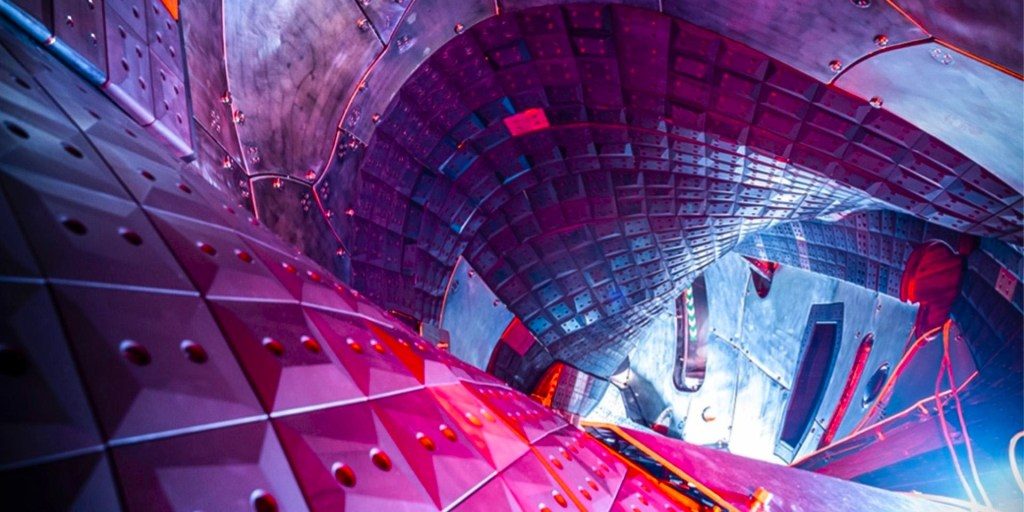
A new fusion record was set thanks to researchers in Germany and the United States. The international effort moves the world one step closer to a commercial fusion power plant, which will need to run continuously at temperatures hotter than the sun.
The record-breaking machine, known as the Wendelstein 7-X (W7-X), is a stellarator. This twisty fusion system confines plasma using external magnets so the nuclei of atoms fuse together and release energy. W7-X is operated by the Max Planck Institute for Plasma Physics (IPP) in Germany and has systems designed and built by the U.S. Department of Energy’s (DOE’s) Princeton Plasma Physics Laboratory (PPPL) and Oak Ridge National Laboratory (ORNL), with support from the Fusion Energy Sciences program in the DOE’s Office of Science.
“This world record marks the highest performing sustained fusion experiment that ran longer than 30 seconds, with record performance lasting for a full 43 seconds,” said Novimir Pablant, the division head for stellarator experiments at PPPL. Pablant said if they can reach this record for 30 seconds, there’s every reason to believe these plasma conditions could be sustained for weeks, months, or even years because 30 seconds is long enough for the scientists to see the relevant physics at work. “This experiment ran long enough that nothing is changing any longer in terms of the plasma or experiment conditions.” However, there are technical challenges still to extending this discharge to, say, 30 minutes or more, related to the reliability of technology.